The Intrapersonal Voyager (Out of the House)
Official Project Technical Report & Manifesto is archived and indexed by CERN Data Centre:

“The Intrapersonal Voyager (Out of the House)” is a long-term process-based SciArt project by conceptual artist Chira Ona, unfolding as a daily ritual-investigation that materializes on canvas the fading connection with the interstellar spacecraft Voyager 1. The artist uses authentic IBM-standard paper punch cards and black canvases to log the data. The performance begins on November 1, 2026—a symbolic choice, as November marks the historical threshold (approximately November 18, 2026) when the signal delay from the spacecraft to Earth will reach exactly 24 hours for the first time in history.
The project will continue until the spacecraft completely loses radio contact with Earth. The exact date when its signal will disappear forever into deep space remains unknown; however, NASA estimates that its nuclear batteries will be depleted around 2030–2031.
The project belongs to the genre of process art, where the passage of time and the daily tracking of change form the core artistic expression. The artist openly integrates her own neurodivergence into the practice: her structural thinking, need for routine, and capacity for extended hyperfocus serve as her primary tools—a way to build internal order against external and social chaos.
The Data Transfer Algorithm
Every day (between 00:00 and 02:00 UTC), Chira Ona reads the technical telemetry data regarding the spacecraft's status and coordinates from the NASA DSN Now server, translating these numbers into material form in two stages :
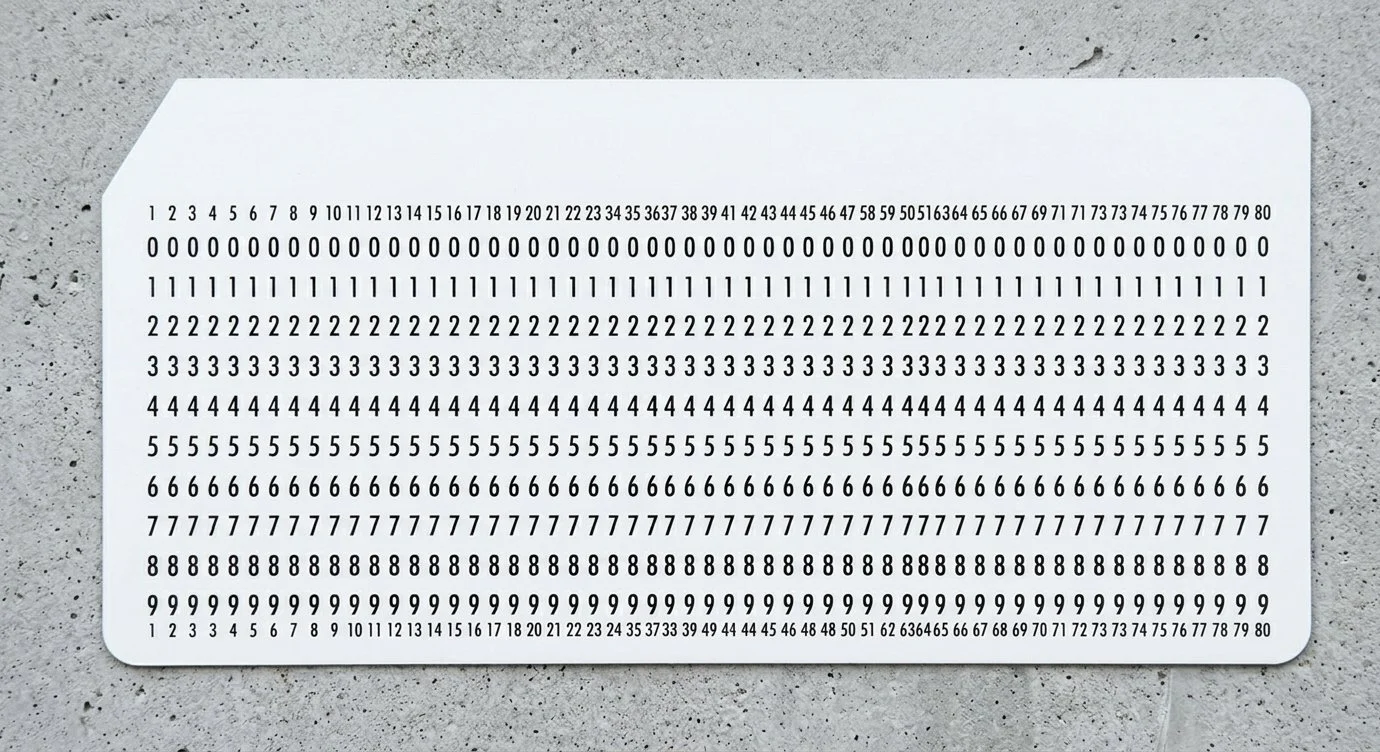
IBM-Standard Paper Punch Cards: The artist takes the current data of the spacecraft—date, light travel time (LTT) signal delay, distance in astronomical units (AU), number of active instruments—and encodes them using the original EBCDIC character system for IBM computers. The resulting complete onboard log is punched as rectangular holes into the paper card. The choice of this medium is conceptual, as punch cards were used in the 1970s to code and program the onboard systems of Voyager 1 itself.
Canvases: From the entire dataset recorded on the punch card, Chira isolates only the signal delay coordinates (in HH:MM:SS format) and manually applies them with white paint onto black canvases. All parameters are rendered at an original 1:1 scale to the actual punch card, where the height of each horizontal row on the canvas strictly equals the height of the paper medium itself—8.25 cm. In this way, the time blocks form a delicate, rigorous micro-barcode across the fabric
The dimensions of each canvas are scaled at a 10:1 ratio to the 1975 Tektronix laboratory oscilloscope, whose horizontal screen was used to display the first binary pulses of Voyager 1's flight computer at NASA JPL. The artist rotates the canvases vertically to improve visual structure and build a rhythm of the code across the display space.
The structure of each piece adheres to a strict mathematical proportion: 5 seconds of radio signal delay equals 1 millimeter of blank space on the canvas.
As the spacecraft travels further away, the light travel time to Earth increases (averaging 5 seconds per day). Due to Earth's orbital rotation around the Sun, this increment fluctuates unevenly; however, the scale strictly records reality, causing the empty space between daily entries to expand continuously. On the initial canvases, data blocks run close together. Towards the end of the mission, large fields of blank space will occupy the canvas, leaving only solitary white barcodes of time.
Existential Concept
Modern culture has largely confined individual consciousness within the loops of digital hyper-reflection and continuous self-analysis, focusing heavily on daily domestic and psychological issues. This self-absorption leaves little room to look at the sky or comprehend our place within the universe. The foundational sense of wonder and awe before the infinite is lost—the very perception that returns a true sense of scale to human consciousness.
Voyager 1 is currently traveling through the absolute darkness and silence of interstellar space, far beyond the reach of our Sun. In the context of the project, the artist employs this trajectory as a metaphor for the human psyche venturing into the uncharted territories of the deep subconscious, where the coordinates of civilization fade away.
Documenting the spacecraft's movement in this performance is the author's attempt to remind us of the actual dimensions of our existence. It is an attempt to prompt the realization that humanity is only a small part of the Universe, and we are all astronauts traveling through the unknown at 600 km/s on a massive cosmic vessel named Earth. Ultimately, it is an attempt, through juxtaposition with the infinity of space, to highlight the limitations of the self-absorbed ego, renew our wonder toward the world, and remind us of the value of our shared home.